
Approximately 850,000 Tons of Greenhouse Gas Emissions Avoided Annually Across Japan and the US; Toys Category Added to Calculations for the First Time This Year
Mercari, Inc. (“Mercari”) has published its FY2026.6 Impact Report, a report consolidating information on the efforts Mercari made throughout FY2026.6 to realize its Group mission, “Circulate all forms of value to unleash the potential in all people,” and the impact of those efforts on society and the environment.
This report covers Mercari’s initiatives across its five material topics in FY2026.6 (July 1, 2025–June 30, 2026). This year’s edition adds the Toys category to the scope of calculating positive impact (contribution to avoided emissions) generated through Mercari’s business activities, along with a review of the calculation methodology. The report also includes a progress update on Mercari’s journey toward becoming an “AI-Native company,” one year since its declaration, and the impact that has been created as a result.
https://pj.mercari.com/impact-report/FY2026_6_ImpactReport_EN.pdf

Highlights from the FY2026.6 Impact Report
Positive impact of Mercari’s business (contribution to avoided emissions)
Manufacturing a new product generates environmental burden throughout its product life cycle, from gathering raw materials to disposing of the product. At Mercari, we believe that utilizing secondhand items in place of new ones can reduce this environmental burden.
Across the categories included in the calculation, in FY2026.6, transactions on Mercari in Japan and the US contributed to avoiding approximately 850,000 tons of greenhouse gas emissions annually.1,2 This is equivalent to approximately 350 covered baseball stadiums.3 For this year’s edition, we have revised the calculation methodology to obtain more accurate figures.

Clothing waste avoided through reuse on Mercari is equivalent to approximately 6.6% of Japan’s annual clothing waste
Approximately 37,000 tons of clothing waste is avoided by listings on Mercari. This is equivalent to approximately 6.6% of Japan’s annual clothing waste.
Selling or buying one item of clothing on Mercari helps avoid approximately 11.8 kg6 of greenhouse gas emissions on average, and it also extends the usage life of each item of clothing by 4.7 years compared to buying and using only new clothing.

Toys find new life on Mercari, extending average usage life by 4.3 years
This year, we added the Toys category to the scope of our positive impact calculations (contribution to avoided emissions). Toys bought and sold on Mercari gain a new life with their next owners, extending their average usage life by 4.3 years.9
By connecting people who see different value in the same item, Mercari helps keep items in circulation and creates new opportunities for their continued use.

Information on Mercari’s own greenhouse gas emissions and progress toward reduction targets is also disclosed in this report and in Mercari’s ESG data.
Evolving into an AI-Native company: Progress and impact
In the year since declaring our commitment to becoming an AI-Native company, we have transformed our operations through our AI Task Force, a cross-functional team with members selected from across the company. This task force conducted a comprehensive review of over 3,800 business processes across 33 areas, helping us rebuild our products, ways of working, and organizational structures around AI.
As a result, the rate of adoption of AI tools has reached 100% among all employees.12 Through ongoing initiatives such as AI Agent Day, which empowers non-engineering members to build AI agents for their work, we have achieved productivity gains equivalent to 495,000 hours out of a potential one million hours identified through our AI-Native transformation.13 Furthermore, we have identified 770,000 hours of potential gains that can be achieved by transforming our business processes with AI. In the engineering organization, the development output per engineer has increased approximately 7.6 times compared to pre-AI levels (FY2024.6).14
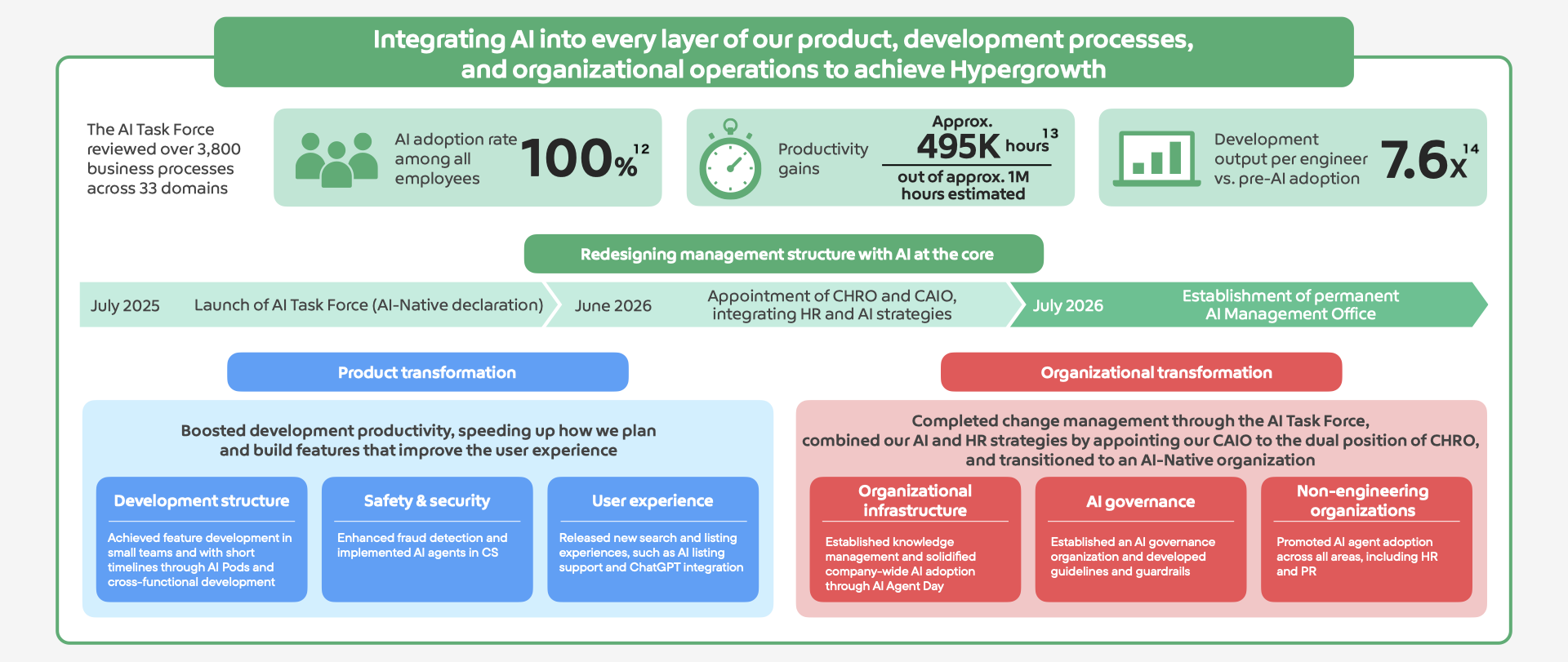
In terms of our organization, we have redesigned our management structure for the AI-Native era, including the appointment of a combined CHRO and CAIO role and the establishment of a permanent AI Management Office. In addition, we have established a dedicated AI risk management team to ensure that innovation and safety go hand in hand.
In FY2027.6, we will move beyond using AI solely to improve productivity and streamline operations. We will aim to redesign our business processes and organization with AI agents at the core, thereby unleashing the potential of every individual to create value, maximizing value for our users, and achieving Hypergrowth.
“Leverage AI for Hypergrowth” — Mercari Announces New Slogan for FY27.6
https://careers.mercari.com/en/mercan/articles/61733/
Enhancing initiatives for safety and security
We put into action our two commitments—the thorough elimination of fraudulent users and thorough aid for users—and published the progress and results of these efforts for the first time in our first Transparency Report.
Through steady progress on these two commitments and building a safe and secure transaction environment, the rate of transaction-related inquiries15 reached an all-time low of 0.35%. Additionally, the compensation rate under our full coverage support program stands at 99.5%,16 with compensation provided in the majority of eligible cases, and compensation to users completed approximately 1.5 times faster than last year (from 51.4 hours in the first half of 2025 to 35.3 hours in the first half of 2026).
Mercari Publishes Transparency Report for First Half of 2026 on Plan of Action for a Safe and Secure Marketplace (available only in Japanese):
https://about.mercari.com/press/news/articles/20260803_transparencyreport/

In October 2025, we established a new policy in line with our Marketplace Principles under which we may prohibit listings and take other measures against items that could significantly compromise the safety and security of our marketplace. Together with this policy, we also published a white paper on the philosophy and discussion process behind the Marketplace Principles.
Mercari Publishes White Paper on Marketplace Principles and New Response Measures (available only in Japanese)
https://about.mercari.com/press/news/articles/20251009_principles/
Other initiatives
Launching the Mercari Global App in the US to further expand the circulation of all forms of value
July 2026 marked the 13th anniversary of the Mercari app. Cumulative listings surpassed 5 billion in January 2026, while approximately 270 million transactions took place over the past year—equivalent to around 8.6 transactions every second.
The gross merchandise value (GMV) of our crossborder business has grown more than 19 times in the past 4 years, exceeding 112.2 billion JPY in FY2026.6. Following its launch in Taiwan and Hong Kong, the Mercari Global App for overseas buyers expanded to the United States in June 2026.
New partnerships are also driving efforts to circulate digital assets and other diverse forms of value, and support the empowerment of all individuals. These include a capital and business alliance with Suruga-ya for collaboration around reuse, a partnership with ECOММIT to build infrastructure for collecting and recirculating used goods, and a business partnership between Mercoin and Coincheck to broaden access to cryptoassets.
Unleashing the potential in diverse talent worldwide: Reducing the gender pay gap to a statistically insignificant level
We believe that diversity is a source of innovation and that inclusion & diversity is essential to achieving our mission.
In FY2026.6, the percentage of women directors remained high by international standards at 58.3%. Through regular monitoring and continued action since FY2023.6, we also reduced the unexplained gender pay gap to a statistically insignificant level.

Through our business and corporate activities, Mercari will continue to contribute to realizing a society where all forms of value can be circulated and the potential of all people can be unleashed. We will continue striving to do our part in creating a circular economy by taking action to promote reuse and providing alternatives to throwing items away.
https://about.mercari.com/en/sustainability/
1. Target categories: Clothing; Electronics; Media (books, CDs, DVDs, etc.), Bags; Shoes; Washing Machines; Toys. Note that this fiscal year, we added earphones to the Electronics category, expanded Clothing, Bags, and Shoes to include items outside the Fashion category (such as Sports; Outdoor Activities, Fishing & Travel Supplies; etc.), and newly added the Toys category in our calculations.
2. Calculations based on items for which a transaction was completed in the target categories on the Mercari Japan and Mercari US services from April 2025 to March 2026. Transactions in the target categories account for 46.5% of total transactions.
3. CO2 equivalent to one covered baseball stadium: approx. 2,436 t-CO2 (volume of Tokyo Dome: 1.24M m3 = 1.24M kL; 1 mol = 22.4 L = 44 g-CO2; Source: Tokyo Dome)
4. From “How Much Carbon Dioxide Do Forests Absorb?” published on the website of the Forestry Agency (available only in Japanese)
5. From “Carbon Dioxide Emissions in Transport Sector” published on the Ministry of Land, Infrastructure, Transport and Tourism website (available only in Japanese)
6. In this FY2026.6 Impact Report, to obtain more accurate figures, we have revised our calculation method as follows: [1] Updated relevant figures based on the results of the latest surveys (conducted in March and May 2026); [2] Updated the emission factor source due to updates to data from AIST-IDEA (National Institute of Advanced Industrial Science and Technology and AIST Solutions); and [3] Revised the adoption of calculation coefficients in manufacturing processes from an LCA perspective
7. CO2 emissions from household air conditioner usage estimated at 0.36kg/h; from the Decokatsu Database published on the Ministry of the Environment’s website (only available in Japanese) https://ondankataisaku.env.go.jp/decokatsu/decokatsu_db/
8. CO2 emissions involved in manufacturing and disposing of/recycling a 500ml plastic bottle estimated at 0.119kg/bottle; from page 17 of “Analysis of the Environmental Burden of Using Reusable Drinking Containers, Cups, and Bottles” published on the Ministry of the Environment’s website (only available in Japanese) https://www.env.go.jp/recycle/yoki/c_3_report/pdf/h23_lca_01.pdf
9. Estimated based on a survey of users who listed or purchased items in the above categories on the Mercari app between February 28 and March 10, 2026 (respondents: 731 sellers and 446 buyers)
10. The first owner’s period of use (an average of 1.8 years) was estimated using responses from sellers and reflects only actual use, calculated by subtracting the time the item was kept unused or in storage from the total period of ownership
11. The lifespan of a toy (an average of 6.1 years) is the sum of the first owner’s actual period of use (an average of 1.8 years), the buyer respondent’s actual period of use (an average of 1.0 year), and the buyer’s expected future period of use (an average of 3.3 years)
12. Percentage of Mercari Group employees using at least one major AI tool (ChatGPT, Gemini, Claude, Cursor, LiteLLM, or Notion AI) as of the end of January 2026. Employees on leave, employees whose departure had been confirmed, and Kashima Antlers employees are excluded.
13. Estimated by applying the percentage of reduction in time spent on applicable tasks achieved through AI use, assuming 100% AI tool adoption rate by employees (as of the end of January 2026)
14. Development output per engineer, calculated by dividing the volume of code changes across Mercari Group in FY2024.6 and FY2026.6 by the number of engineers in the corresponding fiscal year
15. Rate of transaction-related inquiries: Referred to as the “transaction dispute rate” in the previous two transparency reports. The percentage of transactions, out of all transactions, for which we received an inquiry regarding issues such as item defects or non-delivery.
16. Percentage of items received at the Item Collection Center for which compensation was provided (non-compensated cases were mainly due to transaction cancellations)
17. Rate of fraudulent transactions encountered: Percentage of transactions determined to involve fraud or repeated inappropriate use of the service
18. Compared to the same period last year (first half of 2025)